Which Powers a Remote Site Better, Solar or Inverter?
Which Powers a Remote Site Better, Solar or Inverter?
There will be no one around to reset a relay on a hill. Decide whether you need solar panels or a stand alone inverter at your site for your off-grid network. Also decide how big your battery back up will be.
Guides
Contributor By:
Maxwell Kamau
26 Oct,2026, 9:37
Your relay will be located in a spot that is on a hill, water tank, tall mast, etc.
You won’t have anyone living there, and if you lose power, you’ll be without power, and all customers behind your relay will be without too.
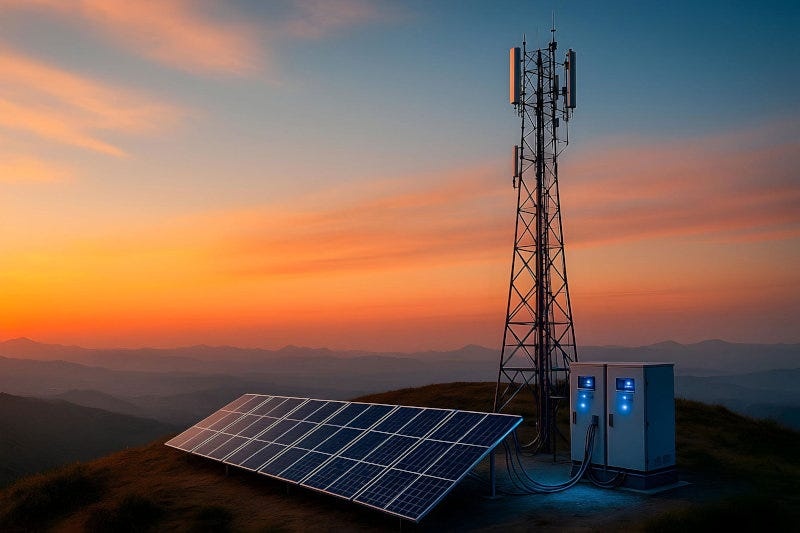
Power can be supplied via solar panels, a controller, or a generator with an inverter and battery.
Often people consider these similar; however, they are very different. The cost and reliability can vary greatly.
What are they?
Solar power requires four components.
The panels convert the sun into electricity. The charge controller manages the electricity and safely charges your battery. The best type of controller is MPPT, which will extract more power from the panels. The battery stores your power for when it is night or cloudy. All your kit runs directly from the battery. Most relay kits will run on low-voltage DC, so nothing needs converting.
The inverter requires some different components. The inverter/charger takes either grid or generator power. It will charge your battery when there is power and convert the DC power from the battery to AC grid style when there is no grid power.
All your kit will plug into the AC supply. Each piece of kit will have its own small converter to convert the AC back to DC.
This means there are two conversions. It is assumed that there will be a grid or generator to charge the battery, so if you have a hilltop with no grid power, there will be nothing for the inverter to work with.
A hybrid inverter will take solar panels and the grid. This is more suitable for larger or busy sites that require more safety. Solar and generators can be used together. Common for hubs where they can’t afford to lose power.
Relay Example
To show the difference, let us look at a simulated relay.
The router takes 6W, 2 radios take 8W each, and cables and PoE loss add 3W. Total 25W all the time. This means we are using 600Wh per day.
Solar with DC:
To get an accurate idea, you should calculate based on the worst month of the year. Long rains occur between March and May, and short rains occur between October and December, meaning less sun. A good average for Kenya is around five peak sun hours.
But let us design for three cloudy months.
Panel Watts = Energy Used Per Day / (Sun Hours x 0.7). So 600 / (3 x 0.7). This will give us approx. 286W. Round it up to 300W. Battery—Many designs in Kenya are designed to last 3 days with no useful sun. This is common practice according to one government report. 3 days = 1800 Wh. Lithium Iron Phosphate (LiFePO₄) batteries can safely discharge about 80% of their rating.
We will also have a bit of loss in the wiring and conversion, so we will assume 92% efficiency. 1800 / (0.8 x 0.92) = 2450 Wh. Two 12V 100Ah lithium batteries will hold approx. 2560 Wh. So this fits.
Inverter:
Assuming you have access to grid power.
Small inverters will use power just by being on. Often between 10 and 25 W. They can also have a loss of 10-15% as heat.
I will use 15W idle and 88% efficiency as examples. Check your model. This means the battery has to provide approx. 25 / 0.88 + 15 = 43 W. This is nearly 1000Wh per day instead of 600. To run this relay with solar and this inverter, you would need approximately 2/3 more panels and batteries. Some inverters will have a low power mode to reduce idle power.
However, they can also fail to wake up for very low loads. Test them first. Most radio solar systems will be designed for DC loads.
Costs, weather, and theft
Costs depend on shops and brands. Get some quotes. But generally a 12V 100Ah lithium battery can be between KES 25,000 and KES 42,000.
A 100W panel is approx. KES 6000. For this solar example, 3 panels would be approx. KES 18,000. 2 batteries would be between KES 50,000 and KES 84,000.
An MPPT controller, fuses, cables, and mounting would be approx. KES 10,000 to KES 20,000. This totals from approx. KES 80,000 to KES 120,000.
Using an inverter for a site with an existing grid.
An inverteror UPS would be approx. KES 10,000 to KES 25,000. 1 battery and wiring. Total approx. KES 40,000 to KES 75,000. This is only cheap if you have a grid already. Getting a grid to a remote hilltop can be more expensive than the entire solar system.
In Kenya, will be sunny, but there will be two seasons of cloudy and rain. Hill tops can be quite misty. Panels will get dusty and bird poo. Panels should be mounted at a slight angle, often 10-15 degrees near the equator.
This will help rinse them with rain.
Ask your installer what angle to use. Hill tops get struck by lightning, so make sure the mast and kit are well earthed. All cables leaving the mast should have surge protection. Theft is the biggest silent cost. Panels and batteries will disappear from remote sites. Secure your panels with bolts. Use tamper-proof fittings. Lock and secure the battery box. Try to hide it. Hot cabinets will reduce battery life. Keep it shaded and ventilated. You will have to go to remote relays.
Try to use systems that don’t require a lot of visits. Lithium doesn’t need any watering. Oversize the battery slightly.
Ask someone qualified to do the wiring. This can cause fires if done incorrectly.
How to Decide
Most of the time you can decide based on 3 questions.
1. Do you have a good grid nearby? If not, or if the quote is high, then solar with DC is almost always the way to go.
2. If you have a grid nearby, how often does it fail? Use an outage log. If only failing for 20 mins a few times per month, then a battery with a DC charger or small UPS is enough. If failing for many hours often, then often solar will be needed.
3. How many customers are behind the relay? If only supplying 2 houses, then a basic option will do. If supplying an entire estate or other towers, then 2 sources should be used. Solar and grid with hybrid inverter. In some cases a generator may also be needed.
If you don’t have a grid, then solar with DC loads. If you do have a good grid with occasional outages, then a charger and battery or small inverter. If you have a poor grid and important customers, then a hybrid. Solar to main power and grid to supplement.
Be mindful of voltage. Many Mikrotiks will tell you what voltage they are receiving. You can set alerts from your office router.
Write down your relay’s wattage. Add it up. Work out the true costs over five years, factoring in battery replacements, site visits, and the day it goes down.
Choose what you would be happy with during the rainy season.
Start earning today with Noch Wired
Popular Posts